
Last Updated: May 5, 2026
Case Status: Open
Latest Update: Miami Waterkeeper has filed a new legal appeal in federal court (26-1105). We are continuing our challenge against the decision to keep the Turkey Point nuclear plant running for an additional 20 years without adequate environmental review.
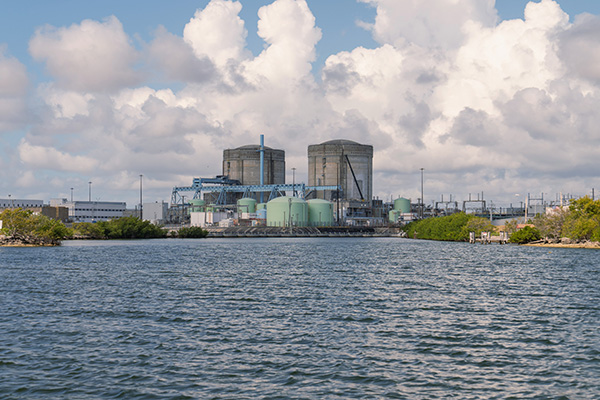
Florida Power & Light’s (FPL) Turkey Point nuclear plant sits between the Everglades and Biscayne National Parks, directly above the Biscayne Aquifer and just 25 miles south of Miami. In 2018, FPL sought to extend the plant’s operation to 80 years despite growing concerns about climate risk, aging infrastructure, and groundwater contamination from its cooling canals. In 2022, Miami Waterkeeper’s challenge led the NRC to roll the license back to 2032 and require updated environmental reviews for nuclear plants nationwide. Since then, FPL has completed that review, the Nuclear Regulatory Commission (NRC) has reapproved the extension, and Miami Waterkeeper’s appeal on the license extension has been denied. The fight now continues to protect South Florida’s water, ecosystems, and communities.
Take Action to Protect South Florida’s Water
While federal regulators debate Turkey Point’s future, Miami-Dade has the power to address the groundwater contamination happening right now.
Extending an Aging Nuclear Plant
In 2018, Florida Power & Light sought a 20-year license extension that would allow the reactors to operate into the 2050s — without fully accounting for climate risks.
Miami Waterkeeper and partners stepped in. Through rigorous scientific analysis and fearless legal advocacy, we challenged the Nuclear Regulatory Commission’s license extension. In 2022, we won. The NRC issued two orders, one rescinding FPL’s nuclear reactor license renewal and reinstating the original license expiration date to the 2030s. Another, requiring both a full environmental review of the impacts of operating the aging Turkey Point nuclear reactors through 2050 and an assessment of the environmental implications of all license renewal requests of nuclear power plants across the country. Soon after, the U.S. Government Accountability Office echoed our concerns, urging the NRC to fully account for climate change in nuclear licensing decisions.
This was hyperlocal advocacy with nationwide impact.
FPL’s license was granted in 2024, prompting another appeal by Miami Waterkeeper after FPL re-applied for a license extension. In March 2026, the NRC denied Miami Waterkeeper’s appeal of the renewal decision, allowing the license extension to remain through 2053.
Miami Waterkeeper maintains that the current environmental review ignores critical risks. These include groundwater pollution from the plant’s cooling canals, potential impacts to South Florida’s drinking water supply, and how rising sea levels and environmental threats make long-term operations riskier and unsafe.
To fight this, we have filed a new legal appeal in federal court (26-1105). We are continuing our challenge against the decision to keep the Turkey Point nuclear plant running for an additional 20 years without adequate environmental review.
Our goal is simple: to make sure federal regulators fully study the risks to our environment and public health and implement the necessary safeguards before allowing the plant to operate until 2053.
Our Response to the NRC Decision
Following the Nuclear Regulatory Commission’s decision to reapprove Turkey Point’s license extension, Miami Waterkeeper is formally challenging the ruling in Federal Court, raising concerns about climate risk, aging infrastructure, and ongoing groundwater contamination. Our press release outlines why this decision falls short—and what’s at stake for South Florida.
Turkey Point’s Cooling Canals
South Florida’s geology is made up of limestone, a porous rock full of holes. Water flows throughout these holes, and so do pollutants. This means contamination doesn’t stay contained and can spread through the aquifer, which is the sole source of drinking water for over four million South Florida residents.
To cool its reactors, Turkey Point uses a massive network of open-air canals carved directly into this porous rock. Because the cooling canal system is unlined, water moves easily from the canals into the Biscayne Aquifer below, carrying with it contaminants and large quantities of salt, spreading into the Biscayne Aquifer. This dense, contaminated water has been sinking into the groundwater and then spreading for miles underground, moving closer to public drinking water supplies.
After many legal challenges, Florida Power & Light was ordered by Miami-Dade County and the Florida Department of Environmental Protection to clean up the contaminated plume. The company is currently attempting to do this through a recovery well system intended to withdraw the polluted water from the ground. However, a 2020 peer-review study of Florida Power & Light’s remediation plan progress, as well as several other independent studies and county technical reviews, found that the plan appears unlikely to meet its goals of containing and retracting the plume.
In the News
2025
Bloomberg
Miami’s Drinking Water Is Threatened by a Florida Nuclear Plant
June 6, 2025
WPLG
Plume of salty water from South Florida power plant could impact Miami-Dade aquifer
May 21, 2025
WPLG
Don’t Trash Our Treasure: Is Turkey Point safe in this age of climate change?
May 14, 2025
WLRN
Turkey Point: A fight is brewing over freshwater pollution
March 19, 2025
The Guardian
Ageing nuclear plant in Florida at risk from climate crisis, advocates warn
March 1, 2025
Miami Herald
Is Turkey Point prepared for future risks? | Opinion
February 20, 2025
2023
Florida Specifier
Miami’s nuclear neighbor: FP&L’s Turkey Point Reactor provides power to millions
April 19, 2023
2022
NBC
Is Miami’s nuclear power plant ready for sea level rise?
October 20–21, 2022
2021
Miami Herald
Safety at Turkey Point is concerning | Opinion
September 24, 2021
Miami Herald
Safety concerns at Turkey Point are rising, along with the sea level | Opinion
August 24, 2021